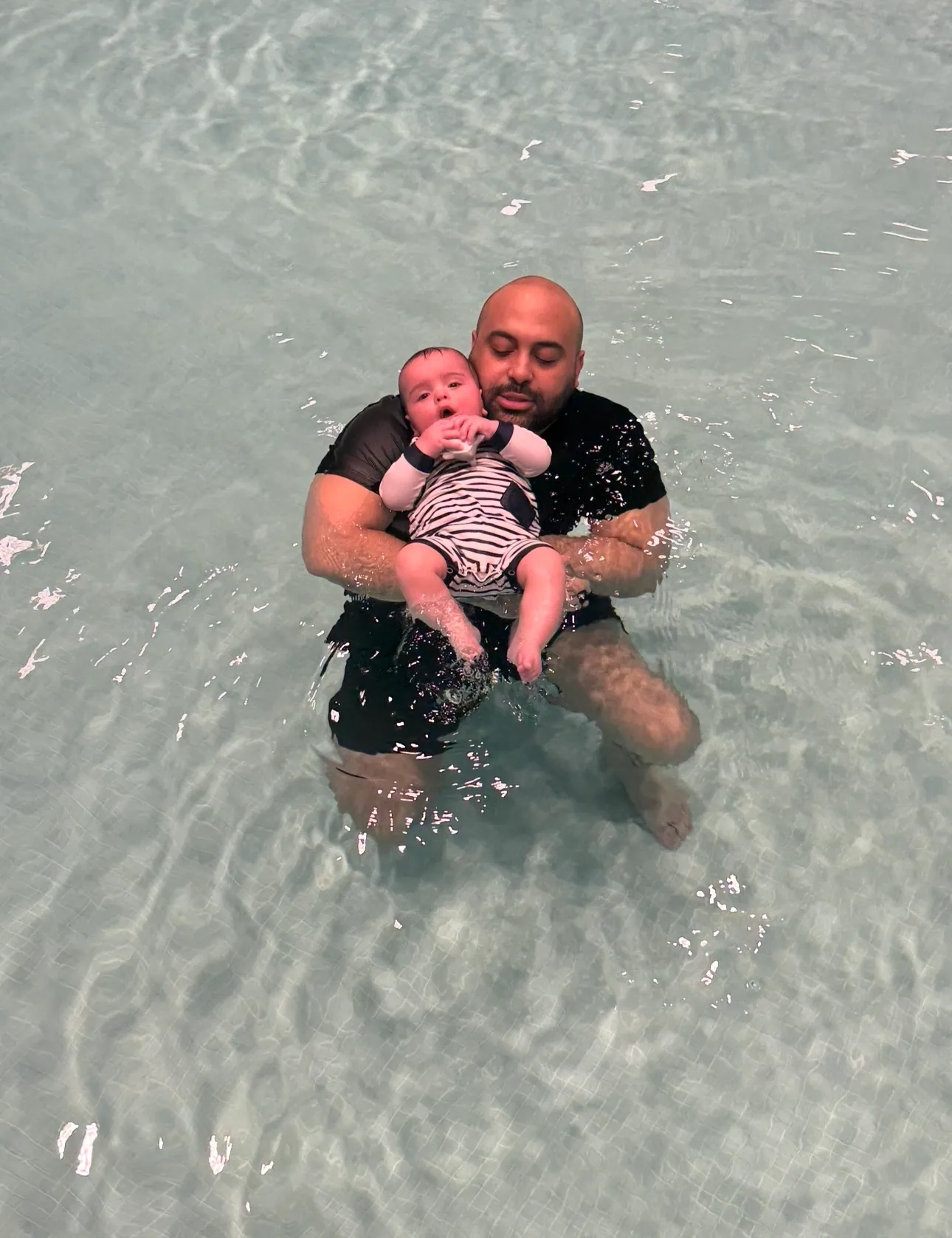
The five water safety tips every NYC parent should know are simple: keep young kids within arm's reach near water, start swim lessons early, learn CPR, use real life jackets instead of floaties, and enforce pool rules every time. Drowning is a leading cause of accidental death for children ages 1 to 4, and it often happens fast and quietly. These habits are the layers that keep it from happening.
New York has more pools than people think: building amenity floors, rooftop pools, condo towers, backyard pools in Queens and Staten Island, and summer trips to the shore. Here is how to put each tip into practice.
1. Keep Young Children Within Arm's Reach
Supervision is the first and most important layer. "Watching" means more than being in the room. For young children and new swimmers, it means staying close enough to reach them right away.
Drowning rarely looks like the splashing and shouting you see in movies. A child in trouble often slips under quietly, in seconds. It can happen in a few inches of water, including a bathtub.
How to do it
- Name a water watcher. At a pool party or family swim, one adult watches the water and does nothing else. Trade off every 15 minutes.
- Put the phone away. Texts and emails pull your eyes away longer than you think.
- Take the child with you. If you need to step away, even for a minute, bring the child out of the water.
- Watch bathtubs and buckets too. Never leave a baby alone in the bath.
Watch closely during transitions
Many close calls happen when routines change. The end of a pool party, when adults are packing up. A visit to a friend's building with a pool you do not know. The first warm weekend at a backyard pool in Queens. Those are the moments to tighten supervision, because everyone assumes someone else is watching.
2. Start Swim Lessons Early
Swim lessons lower the risk of drowning for young children. The American Academy of Pediatrics supports lessons for many kids starting around age 1. At Little Swimmers NYC, we start babies at 4 months, with a parent or caregiver in the water, to build comfort and early safety skills.
Lessons do not make a child drown-proof. They give your child skills that buy time: rolling onto their back, floating, getting to the wall and climbing out.
Safety skills we teach first
- Back float. A child on their back can breathe and call for help.
- Rolling from front to back. So a child who falls in face-first can turn over.
- Getting to the wall. Turning around and reaching the nearest edge.
- Climbing out. Using the steps or pulling up at the wall without help.
Babies and toddlers build these safety skills first, before strokes. Most children show significant improvement within 5 to 8 lessons. For timing, read When Can My Baby Start Swimming?
Learn in the pool your child uses
Learning in your own pool helps. Your child learns where the steps are, where it gets deep and how to reach the edge in the water they swim in every week. We teach at backyard, building and condo pools across all five boroughs.
3. Learn CPR and Refresh It
If something goes wrong, the minutes before help arrives matter. Knowing infant and child CPR lets you act right away.
Where to learn
Many NYC hospitals, community centers and organizations offer infant and child CPR classes. Look for a course that covers both infants and children, and includes hands-on practice.
Keep it fresh
CPR skills fade. Take a refresher regularly, and make sure nannies, grandparents and anyone else who watches your child near water is trained too.
Every Little Swimmers NYC instructor is certified, CPR and AED trained, background checked and fully insured.
4. Use Life Jackets, Not Floaties
Inflatable arm floaties, rings and pool noodles are toys. They can slip off, deflate or tip a child forward. They also give parents a false sense of security, which can lead to less careful watching.
For a child who cannot swim on their own, use a U.S. Coast Guard approved life jacket that fits properly.
Getting the fit right
- Check the label for your child's weight range.
- Buckle and zip every strap.
- Lift the jacket at the shoulders. It should not ride up past the chin or ears.
- For babies and toddlers, choose a jacket with a head support and a crotch strap.
Life jackets near open water
At the beach, on a boat or near a lake, young children and weak swimmers should wear a life jacket the whole time. Pool skills do not fully transfer to waves, currents and cold water.
Lessons also help kids move past floaties. Tara E. wrote in her Google review that "by the age of three, each of them was confidently swimming without floaties."
5. Set Pool Rules and Enforce Them Every Time
Kids learn rules through repetition. A rule that applies some days and not others is not a rule to a four-year-old.
Rules worth having
- Always ask an adult before getting in the water.
- Walk, do not run, on the pool deck.
- Feet first unless an adult says the water is deep enough for diving.
- No pushing or dunking.
- Stay away from drains and filter openings.
Pool access at home
If you have a backyard pool, a four-sided fence with a self-closing, self-latching gate is one of the most effective barriers. Keep toys out of the pool when it is not in use, so kids are not tempted to reach for them.
In a building, talk with management about how the pool door is secured and whether children can get in on their own.
Putting the Layers Together
No single step is enough. Safety comes from stacking all five: close supervision, swim skills, CPR, the right flotation and consistent rules. If one layer slips, the others are still there.
How Little Swimmers NYC Helps
We teach private lessons at your own pool, from 4 months old through teens and adults. For infants, a parent or caregiver is in the water for the first several sessions. You get progress notes after every session so you know which safety skills your child has and which ones are next.
Your first lesson is a trial charged at the regular rate, and it sets a baseline. Our hours are Monday to Friday 9am to 7pm and Saturday and Sunday 9am to 5pm.
Start With a Trial Lesson
Read more on our lessons page and FAQ, or call 917-755-0378.
Questions parents ask
What are the most important water safety tips for parents?
Keep young children within arm's reach near water, start swim lessons early, learn infant and child CPR, use a U.S. Coast Guard approved life jacket instead of inflatable floaties, and set pool rules you enforce every time.
Do swim lessons make a child drown-proof?
No. Swim lessons lower risk, but no child is drown-proof. Lessons work alongside constant supervision, barriers and CPR knowledge.
Are arm floaties safe?
Inflatable arm floaties are toys. They can slip off or deflate and give parents a false sense of security. Use a properly fitted U.S. Coast Guard approved life jacket for children who cannot swim on their own.
What age should my child start swim lessons?
The American Academy of Pediatrics supports swim lessons for many children starting around age 1. Little Swimmers NYC teaches babies from 4 months, with a parent in the water, to build comfort and early safety skills.